


Comerica, Conduent, and the U.S. Treasury Betrayed Veterans and Other Victims
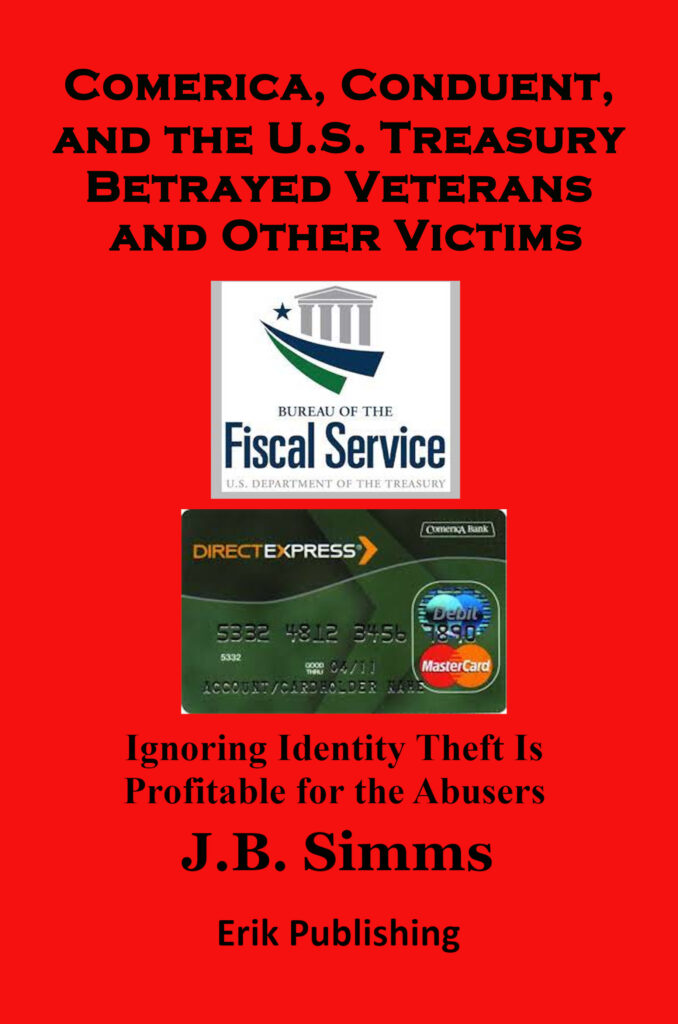
The print and Kindle versions are available at this link on Amazon.com
Comerica Bank distributed millions of Social Security payments on a debit card. The debit card is the Direct Express debit card, and cardholders reported missing money from their accounts. Fraudsters accessed their accounts. Federal banking law, Regulation E, protects cardholders’ accounts. Comerica Bank falsely blamed the cardholders.
How the case began
J.B. Simms lost only $250, but he began an investigation. U.S. Treasury and the Veterans Administration ignored fraud reports. Ultimately, Simms recovered over $300,000 for 103 victims before filing the lawsuit. Afterward, the exposure led to a class action lawsuit. It also led to the creation of a new Veterans Administration division, Veterans Banking. Eventually, Comerica Bank lost a multi-million-dollar contract.
You can find the full article at Comerica in ‘serious violation’ of Treasury’s Direct Express program by Kate Berry, American Banker Magazine.
Comerica Bank officials acknowledged significant compliance failures, exposing the Treasury Department program that provides federal benefits on prepaid cards to millions of unbanked Americans.
A Comerica executive said the Dallas bank faces a “serious contract violation.” A vendor office in Lahore, Pakistan, handles fraud disputes and data on Direct Express cardholders, the documents show.
VA finds a way out
The problems forced the Veterans Administration to devote resources to helping veterans find an alternative. So, by 2019, the VA created the Veterans Benefit Banking Program (VBBP). This consortium of banks and credit unions offers free checking accounts so veterans can receive their monthly payments via direct deposit.
Steve Lepper, a retired U.S. Air Force Major General, president and CEO of the Association of Military Banks of America, worked with the VA to create the program.
Roughly 240,000 veterans now make deposits with AMBA banks. Veterans migrated away from Direct Express, Lepper said. About 80,000 unbanked or underbanked veterans still receive their benefits on Direct Express prepaid cards or paper checks.
J.B. Simms began the investigation and assisted the VA
Lepper credited J.B. Simms, an author and private investigator, who recently published “Comerica, Conduent and the U.S. Treasury Betrayed Veterans and Other Victims.” Simms says the discovery of fraudulent charges on his Direct Express account in January 2017 and a second time later that year. He then sought to help other veterans recover money stolen through fraud, including cases in which veterans’ claims were denied.
After Simms’ revelation, Lawrence, a longtime government consultant, said in an interview. “This has all the makings for a really, really bad situation.”
The internal documents paint a broader picture of the $91.2 billion-asset Comerica’s strategy and third-party oversight of Treasury’s Direct Express program, which serves 4.5 million Americans.
Direct Express deposits roughly $3 billion a month electronically on prepaid cards. Millions of federal government beneficiaries without bank accounts use the cards. Ultimately, the program is part of a government effort to reduce potential fraud and costs by weaning people off paper checks.
Foreign outsourcing is against the law.
“It is a clear violation of the contract Comerica held with the Department of the Treasury to locate the vendor in a foreign country,” said Weber, special counsel for enforcement at the Office of the Comptroller of the Currency.
Comerica was paid $151 million in 2020 to operate Direct Express. It received roughly $770 million in total gross revenue over a six-year period, from 2015 to 2020, to run the program.
“As a global provider of banking and payment services, we naturally employ a global workforce,” i2c said.
The Treasury’s Bureau of Fiscal Service did not return calls seeking comment. The Treasury’s Office of Inspector General said it had no comment.
Inadequate fraud reporting
A federal judge certified a class action against Comerica and Conduent brought by Direct Express cardholders because fraud drained their accounts of thousands of dollars from 2015 to 2022. The class action showed that Comerica and Conduent denied refunds to cardholders who alleged fraud on their accounts.
The vulnerability of unbanked cardholders is the big issue and was exposed.
Alleged violations
Simms and others say Comerica’s failure to address problems with Direct Express should be aired publicly because more victims need to be aware.
“The Direct Express cardholders are the most vulnerable population of all Social Security recipients. Most do not have bank accounts and lack the sophistication to challenge any authority,” said Simms.
Some Social Security recipients said they have not been notified of the class action or any efforts by the bank to reimburse them.
Regulation E requires a financial institution to investigate fraud within 10 days of being notified by a cardholder, but the bank can take up to 45 days to investigate if it provides provisional credit in the amount of the alleged error. Experiencing fraud is devastating.
“Every month we relive the nightmare from five years ago,” says Jackie Densmore regarding monthly inserts she receives in her brother-in-law’s check.
What’s next for Comerica customers?
Court documents show that in May 2019 alone, Comerica received 15,712 fraud disputes. Taylor said in court documents that Comerica had no data to identify cardholders who reported fraud (because their vendors had all the customer data). The bank didn’t keep track of money refunded or denied for fraud.
A problem of incentives
Simms and Densmore, the plaintiffs in the class action, blame the problems on shoddy third-party oversight by the Treasury. Meanwhile, no one person was held accountable.
“The Bureau of Fiscal Service, as a part of the U.S. Treasury, allows Comerica Bank to continue violating federal banking laws. It also endorsed the contract with Comerica knowing inaccurate information was submitted by Comerica to obtain the contract,” Simms said, citing the OIG reports.
Ultimately, many officers and attorneys employed by Comerica were given severance packages and left Comerica.